
Dr. William Koch's private collection of German Expressionist prints。housed in a modest brick building in Milwaukee, holds over 1,200 works on paper—woodcuts by Kirchner, lithographs by Nolde, and a rare complete set of Die Brücke portfolios. Kochs often acquired directly from artists or their estates, sometimes trading medical equipment for art during the 1950s. That detail—bartering surgical instruments for a Schmidt-Rottluff woodcut—captures something essential about the Kochs family's approach: practical, unorthodox, and deeply personal.
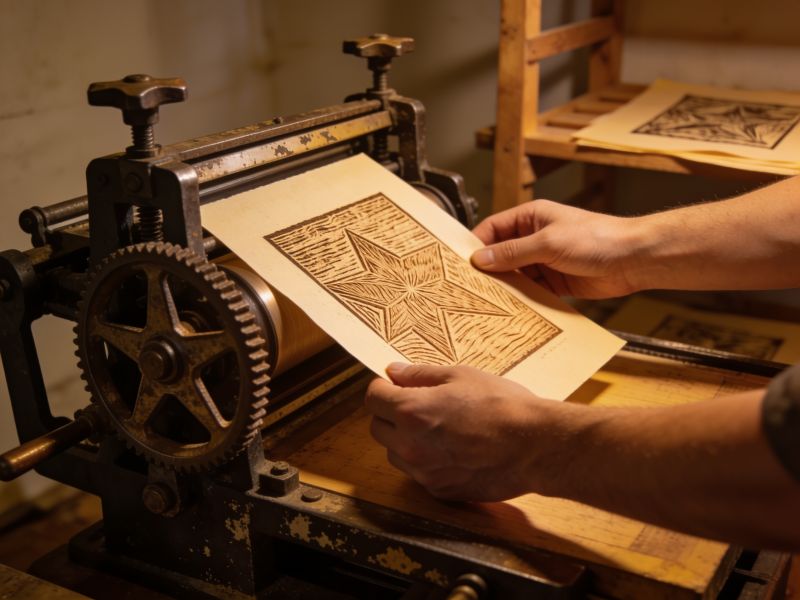
Printmaking runs through the Kochs lineage like a watermark. In the 1920s, Heinrich Kochs ran a small press in Leipzig that produced political posters and illustrated pamphlets for the Social Democratic Party. His grandson, Thomas Kochs, now operates a fine-art printing studio in Chicago, where he collaborates with contemporary artists on limited-edition etchings. Thomas still uses a 19th-century star-wheel press inherited from Heinrich. The connection isn't just sentimental;it shapes his technical decisions. He favors the same damp-paper methods his grandfather used。arguing that “digital gamut tricks can't replicate the way ink sits in a cotton fiber” That kind of continuity—tools passed down, methods sustained—defines how Kochs treat printmaking as both craft and inheritance.Kochs' influence extends beyond the studio. In 2018, the family foundation endowed a printmaking fellowship at the School of the Art Institute of Chicago, specifically for students working in relief and intaglio. The fellowship covers materials。studio access, and a stipend—unusual for an art school program, where printmaking often gets less funding than painting or digital media. I visited the studio last spring;the Kochs Fellow that year, a young artist named Elena Ruiz, was carving a large linocut of a Chicago streetscape. She told me the fellowship's real value was “permission to fail”—the freedom to experiment without worrying about paper costs. That's a quiet but significant intervention in how printmakers develop.
Critics sometimes dismiss Kochs-funded projects as traditionalist, even nostalgic. There's a fair argument there. The foundation's grant guidelines prioritize “historically grounded techniques” and some applications for photopolymer or hybrid digital processes get rejected. But nostalgia isn't quite the right word. Look at the Kochs collection's recent acquisition of works by Dyani White Hawk, a Sicangu Lakota artist who combines intaglio with beadwork imagery—hardly a backward-looking choice. The family seems less interested in preserving a frozen past than in sustaining a living vocabulary of hand-pulled prints. Whether that vocabulary can adapt fast enough to attract younger artists remains an open question. For now, the presses keep running。and the ink keeps drying.